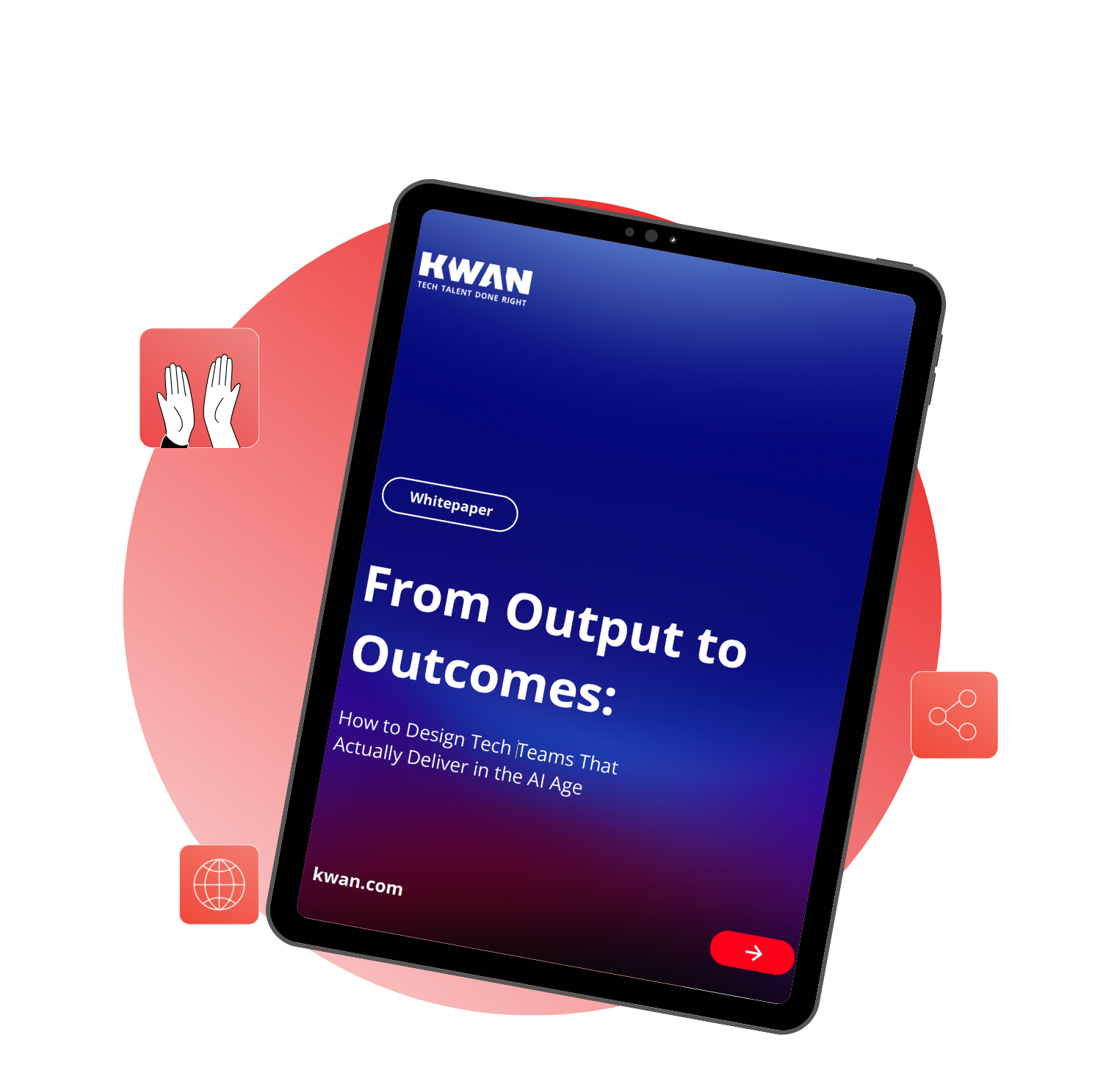
Whitepaper
From Output to Outcomes: How to Design Tech Teams That Actually Deliver in the AI Age
AI can help your team write code faster. It won’t tell them what’s worth building. Download our 2026 whitepaper to learn how engineering leaders can move from output-driven delivery to outcome-driven teams.
EXPERIENCE ACROSS LEADING COMPANIES
experts
Available for client teams
clients
Supported engineering teams
years
Experience building tech teams
From Output to Outcomes
Engineering teams are shipping more than ever.
With AI accelerating code generation, productivity is no longer the hard part. The real challenge is turning output into business impact.
This whitepaper explores why more tickets closed, more PRs merged, and more lines of code do not necessarily mean better results.
From ownership and continuity to alignment and clear outcomes, it offers a practical framework for designing tech teams that actually deliver in the AI age.
What You'll Find Inside
Output vs Outcome
Why more code, tickets and PRs do not necessarily mean better business results and how to spot when your team is busy, but not truly moving forward.
The AI Amplifier
How AI accelerates whatever system it is placed in — creating leverage in well-structured teams, but more noise when ownership, alignment and clarity are missing.
Practical Framework
Five rules for designing tech teams that actually deliver: own a problem, prioritize continuity, measure outcomes, design for ownership and use AI to amplify impact.
Trusted by Industry Leaders
Why Companies Choose KWAN
As a KWANer alumni, choosing KWAN - the best Portuguese company I ever worked for - as our outsourcing partner was an obvious choice: KWAN and Team Resilience’s values and culture are very much aligned.
KWAN’s proactive initiative was a massive benefit. We needed to drastically increase our development staff and KWAN was able to provide the solution by creating a highly skilled team of developers, who fit the cultural and technical requirements.
In an industry such as the tech one, where computers play a major role, it’s refreshing to account on a partner that is human, open, sensitive, and understandable, such as KWAN.
Is this whitepaper for you?
This whitepaper is for CTOs, VPs of Engineering, Heads of Product and technical leaders who feel their teams are working hard, shipping fast and using more AI tools, but still not seeing the business impact they expected.
It is not a technical guide about AI tools. It is a strategic framework for leaders who want to build engineering teams that deliver measurable outcomes, not just more code, tickets or features.
Stop Measuring Activity. Start Driving Outcomes.
Download the full report to explore why more code, more tickets and more PRs do not always mean better results and what to do instead.
Frequently Asked Questions
Output is what an engineering team produces: code, tickets, features, pull requests or deployments. Outcome is the business impact created by that work, such as higher user adoption, faster time-to-market, lower churn, reduced operational costs or improved customer satisfaction.
In the AI age, this distinction matters even more. AI can help teams produce more output faster, but it does not guarantee that the work being shipped creates meaningful business value.
More engineering output does not always lead to better results because teams can be busy building the wrong things. A team may close more tickets, merge more PRs and ship more features while still failing to improve the metrics that matter to the business.
This usually happens when engineering work is disconnected from clear business goals, product outcomes and ownership. Without alignment, speed only amplifies activity — not impact.
AI can improve software engineering teams by reducing time spent on repetitive or mechanical tasks, such as boilerplate code, documentation, test scaffolding or basic code review. This can give engineers more time for higher-value work like architecture, product thinking, technical decisions and problem-solving.
However, AI works best when the team already has clear ownership, strong alignment and good delivery processes. In poorly structured teams, AI can simply accelerate confusion and create more low-impact output.
AI Debt is the accumulation of unverified, bloated, or insecure code generated by LLMs. It creates a "Sugar Rush" of speed today but a maintenance nightmare tomorrow. This whitepaper teaches you how to identify, prevent, and manage this debt, making you the most valuable asset in the room.